
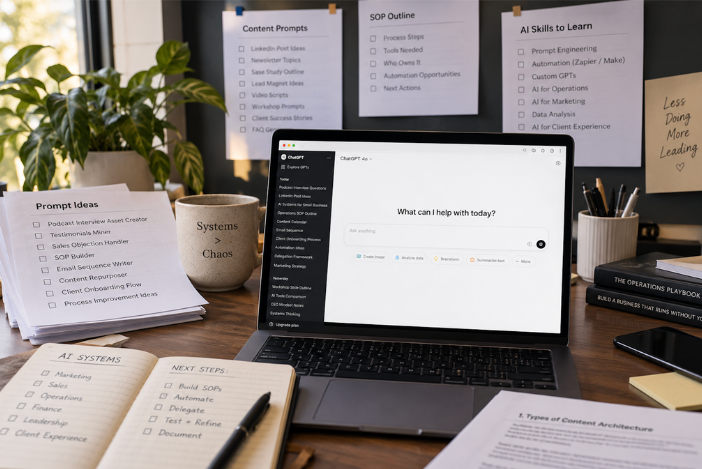
You’ve got a prompt saved somewhere for the emails, a custom GPT that spits out proposals, a project stuffed with notes for the social posts, and every one of them works fine the second you open it. The trouble only shows up when you count them, because somewhere along the way that pile turned into a part-time job you never meant to hire for, and you’re the one working it.
So the week runs on a loop, you lift an output out of one tool and drop it into the next, you type your business background in for the tenth time, then you read every line because today’s version doesn’t match what it handed you yesterday. That’s a person doing manual work around a stack of tools that were sold as the thing that ends the manual work.
A prompt, a project, and a system are three different things
Naming the levels helps, because most people are parked on the bottom one without knowing there’s a top.
The bottom level is just talking to AI, you type an instruction and it hands something back, which is handy when you need a quick task done and worthless the minute you try to build anything that lasts on top of it.
A step up you’ve got skills, custom GPTs and projects, which are more like rooms where you’ve stashed some context so you stop retyping the same background every time you walk in. Useful, genuinely, but a hallway lined with them still won’t run a business.
Above that sits a system, and this is where the thing changes character, because a system is wired into your real data through connectors, it behaves the same way every single time you open it, and once a piece of it has been correct for months on end you can finally let that piece run automated.
At the very top the systems talk to each other, and that’s the level hardly anyone gets to, where the work finally comes off your plate instead of landing straight back on it.
What’s actually inside one system
Every system, whichever one you’re building, carries the same kinds of pieces, and none of them come off a shelf, because every one is drawn from your own business.
- Your business information, meaning how the company actually runs.
- Your client information, who you serve and what they’re really buying.
- Your team information, what each person is genuinely on the hook for.
- Your delivery, how the product or service reaches the client in real life.
- The prompts and skills the system leans on for its specific jobs.
- The knowledge files, the training documents that tell the system what good work looks like.
- The custom instructions, rules and workflows it follows every single time, without being reminded.
Assemble those pieces out of how your own operation actually runs, and the output gets predictable enough that you can build on top of it instead of re-reading every line before you’ll trust it.
The six systems in your business
Zoom out and the whole company is six systems, whether you’ve ever put names to them or not. Marketing pulls in attention and turns it into leads that sales turns into paying clients, delivery gets the product or service into the client’s hands, operations keeps the team and the moving parts coordinated, finance tracks what’s left after the real costs clear, and leadership reads the whole board and calls what changes next.
Say them out loud about your own business and you’ll usually spot the one that’s on fire.
Delivery is the system almost nobody builds
Delivery gets skipped, and I understand why, because every business delivers differently. A one to one service, in-person work, a brick and mortar counter, a course, a productised package, none of them look alike, so it feels easier to leave delivery undocumented and carry it around in your head.
That’s exactly why it earns a system of its own. Map the general shape of how you deliver, then decide which pieces AI can actually help with, whether that’s the onboarding email, the one-page project outline you keep rewriting from scratch, or the handover checklist. Delivery is where clients decide whether they stick around, so leaving it as the loosest part of the business is a strange corner to cut.
Linking is where it becomes an operating system
One solid system already takes real weight off your week, but the shift people don’t see coming is what happens when six of them are linked and feeding each other.
It runs like a chain, your marketing system brings in a lead and tees it up for sales, which then turns that prospect into a signed and paying client, and the signed contract and the paid invoice push that client into delivery, where the actual work gets done while operations keeps the team clear on their part. Finance reads what the team is doing against what the margin looks like once the real costs clear, and the whole thing funnels up to leadership, where you get the honest read on what to change next.
Build those systems and connect them and you’ve got a full business operating system, one that came out of your own business and runs end to end. You can’t download that. A bought template runs the same on every business that installs it, which is why so much AI output sounds like it came off the same assembly line.
Where to start this week
You don’t build all six at once, because that’s how people burn out and quit in month one.
Pick the single system that’s costing you the most right now, the one that swallows your week and that you quietly dread opening because the copy-and-paste is worst there. Build that one properly, out of how your business really works, until you’d put your name on what it produces without a second pass. Then build the next, and only then do you start wiring them together.
AI multiplies whatever it lands on. Set it loose on a heap of disconnected prompts and all you get back is the same mess faster and more sure of itself. Give it one real system to stand on and it starts multiplying what you’re genuinely capable of.
So pick your one, whether that’s marketing, sales, delivery, operations, finance, or leadership, and start there this week, building the thing you’ll still trust six months from now.

